Quick Answer
The UAE has extended its Small Business Relief programme, giving eligible startups, entrepreneurs and small businesses more time to benefit from Corporate Tax relief. Here is what has changed, who may qualify, and what UAE business owners should do next.
Small businesses in the UAE have received an important tax update.
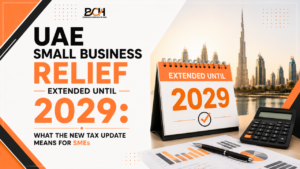
The UAE has extended the Small Business Relief programme through 31 December 2029, according to the latest announcement. The relief was previously scheduled to apply only to qualifying tax periods ending on or before 31 December 2026.
The AED 3 million revenue threshold remains central to the relief, meaning eligible UAE resident businesses that meet the applicable conditions can continue to consider the scheme for their qualifying tax periods.
For entrepreneurs, this extension could provide additional breathing room as they invest in employees, technology, marketing and business expansion.
But there is an important point many headlines may miss: earning less than AED 3 million does not automatically mean a business has no Corporate Tax obligations.
What is UAE Small Business Relief?
Small Business Relief was introduced when the UAE Corporate Tax regime came into effect to reduce the tax burden and compliance pressure on eligible small and micro businesses.
Under the existing framework, an eligible Resident Person can elect for the relief when its revenue meets the required threshold and other conditions are satisfied.
When the election applies, the business is treated as having no taxable income for that tax period.
The scheme is therefore different from simply saying that small companies in the UAE are permanently exempt from Corporate Tax.
The important figures
| Particular | Current position |
| Small Business Relief threshold | AED 3 million revenue |
| Extended period | Through 31 December 2029 |
| Relief mechanism | Eligible business treated as having no taxable income for the relevant period |
| Election | Required for the relevant tax period |
| Qualifying Free Zone Persons | Not eligible |
| Certain large MNE group members | Not eligible |
The original Ministry of Finance decision established the AED 3 million threshold and initially limited the relief to qualifying tax periods ending on or before 31 December 2026.
Why the 2029 Extension Matters
For a growing business, an additional three years can make a meaningful difference.
Startups and SMEs often operate differently from established corporations. During their early years, they may be spending heavily on:
- Hiring employees
- Building products
- Customer acquisition
- Technology
- Marketing
- New market expansion
- Working capital
Extending the relief gives eligible businesses more time to focus on building sustainable operations while potentially benefiting from the relief mechanism.
It also gives founders more time to prepare for the tax position that may apply as their businesses become larger.
The AED 3 Million Threshold: What Does It Actually Mean?
The AED 3 million figure refers to revenue, not profit.
This distinction matters.
Imagine a UAE company generates AED 2.7 million in sales but has significant operating expenses. It cannot simply look at its profit and decide whether it falls under the threshold.
The relevant test is based on revenue under the applicable rules.
There is another important condition: the FTA’s existing guidance states that revenue must be AED 3 million or less in both the current and previous Tax Periods relevant to the election.
A simple example
Suppose a business has:
| Tax Period | Revenue |
| 2024 | AED 1.7 million |
| 2025 | AED 2.1 million |
| 2026 | AED 2.8 million |
The business remains below AED 3 million across these periods.
Now consider:
| Tax Period | Revenue |
| 2024 | AED 1.9 million |
| 2025 | AED 3.4 million |
| 2026 | AED 2.5 million |
The business being below AED 3 million in 2026 does not by itself solve the problem. The previous-period revenue can affect eligibility under the existing rules. The FTA provides a similar example where exceeding AED 3 million in a previous period prevents the taxpayer from claiming the relief in a later period.
This is why businesses should monitor revenue throughout the year rather than checking it only when filing their tax return.
Is Small Business Relief Automatic?
No.
This is one of the biggest misconceptions surrounding the scheme.
An eligible business must elect for Small Business Relief for the relevant Tax Period. The FTA specifically identifies the election as a condition of the relief.
In other words, simply having revenue below AED 3 million does not mean the relief has automatically been applied.
Businesses should review their eligibility and make the appropriate election as part of their Corporate Tax compliance process.
Who Can Claim Small Business Relief?
The relief is aimed at eligible UAE Resident Persons, including both natural persons and juridical persons, subject to the applicable requirements.
This can potentially cover a wide range of smaller businesses, including:
- Startups
- Consulting businesses
- Professional service companies
- Trading businesses
- Small agencies
- Entrepreneur-owned companies
- Other eligible UAE resident businesses
However, the business must satisfy all relevant conditions.
Revenue alone is not enough.
Who is Not Eligible?
Certain businesses are specifically excluded from Small Business Relief.
Qualifying Free Zone Persons
A Qualifying Free Zone Person cannot elect for Small Business Relief under the existing FTA rules.
This is important because Free Zone companies should not assume that having revenue below AED 3 million automatically makes them eligible.
Their Corporate Tax position needs to be assessed under the Free Zone rules that apply to them.
Certain Multinational Enterprise Groups
Members of a multinational enterprise group meeting the relevant conditions are also excluded.
The existing FTA guidance refers to multinational groups with consolidated revenue exceeding AED 3.15 billion.
For most small businesses, this exclusion will not be relevant, but it matters for companies that form part of larger international groups.
Does the Relief Mean Small Businesses Don’t Need to Register for Corporate Tax?
This is where business owners need to be particularly careful.
Small Business Relief should not be confused with being outside the UAE Corporate Tax system.
A business may still have Corporate Tax registration and filing responsibilities even if it qualifies for the relief.
The relief affects the treatment of taxable income for the relevant tax period. It does not mean that a business can simply ignore its tax records or compliance obligations.
Businesses should therefore maintain proper:
- Accounting records
- Revenue records
- Invoices
- Business documentation
- Tax filings
- Supporting evidence for their eligibility
Small Business Relief Is Not the Same as the 0% Corporate Tax Band
Another common misunderstanding is that the AED 3 million Small Business Relief threshold is the same thing as the UAE’s standard Corporate Tax threshold.
It isn’t.
The UAE’s standard Corporate Tax structure generally provides:
0% on taxable income up to AED 375,000
and
9% on taxable income exceeding AED 375,000, subject to the applicable rules.
Small Business Relief operates separately. For a qualifying taxpayer that elects for the relief and meets the conditions, taxable income is treated as nil for that relevant tax period.
This distinction is important when explaining the relief to business owners.
What the Extension Could Mean for Startups
For a startup still establishing its market position, the extension may provide useful financial flexibility.
Instead of allocating additional resources toward Corporate Tax arising under the standard regime, an eligible business may be able to retain more resources for legitimate business purposes during the relief period.
For example, founders may choose to invest in:
- Recruiting a larger team
- Developing new products
- Expanding their digital presence
- Entering new markets
- Improving operational systems
- Building stronger cash reserves
The key is to use the relief as a business planning advantage, not as a reason to artificially restrict growth.
Should Businesses Try to Stay Below AED 3 Million?
Not necessarily.
A company should not avoid genuine business opportunities simply because it is approaching the AED 3 million threshold.
If revenue growth takes the company beyond the threshold, that can be a sign that the business is succeeding.
The better approach is to understand what the tax position will look like once the company no longer qualifies and plan accordingly.
This could include:
- Improving accounting systems
- Forecasting revenue
- Reviewing expenses
- Preparing cash-flow projections
- Planning future tax liabilities
- Getting professional tax advice
Good tax planning should support business growth rather than prevent it.
What UAE Businesses Should Do After the Announcement
The extension is a good reason for SMEs to review their current position.
Review your revenue
Look at both your current and relevant previous Tax Periods rather than considering only your latest sales figures.
Confirm your eligibility
Check whether your company is a Resident Person and whether any exclusions apply.
Review your Free Zone status
If your business is a Qualifying Free Zone Person, Small Business Relief is not available under the existing rules.
Keep your records organised
Your revenue figure needs to be supported by proper accounting records.
Check your tax filing position
If you are already registered for Corporate Tax, make sure your filings and elections are handled correctly.
Plan for the future
Even with the extension, businesses should consider what happens as they grow beyond the relief threshold or after the relief period ends.
What this Means for Entrepreneurs Starting a Business in Dubai
For entrepreneurs considering business setup in Dubai, the tax update is worth knowing, but it should not be the only factor influencing the choice of business structure.
Before establishing a company, founders should consider:
| Business Decision | Why It Matters |
| Mainland or Free Zone | Determines operating environment and applicable regulations |
| Business activity | Determines licensing requirements |
| Ownership structure | Affects company setup and governance |
| Visa requirements | Determines residency planning |
| Banking needs | Influences documentation and financial setup |
| Tax position | Helps with long-term financial planning |
| Growth strategy | Determines whether the initial structure can scale |
A company structure that looks inexpensive at the beginning may not necessarily be the best choice once the business starts growing.
A Practical Example for a Small UAE Business
Consider a Dubai-based consulting company generating AED 2.4 million in annual revenue.
The founders review their position and determine that:
- The company is a UAE Resident Person.
- Its revenue remains within the AED 3 million threshold.
- Its relevant previous Tax Periods also meet the threshold.
- It is not a Qualifying Free Zone Person.
- No other exclusion applies.
If the company meets the applicable conditions and makes the required election, it may benefit from Small Business Relief for the relevant Tax Period.
Now imagine that the same company grows to AED 3.3 million in revenue.
The founders can no longer assume that the relief applies simply because they previously qualified. The company’s tax position needs to be reassessed based on the applicable rules.
Why This is Important for UAE SMEs
The UAE’s Corporate Tax framework is continuing to evolve, and small businesses need to keep up with changes rather than relying on information from the year they incorporated.
The original Small Business Relief decision was specifically introduced to support startups and small or micro businesses and reduce their Corporate Tax burden and compliance costs.
The reported extension to 2029 continues that policy direction and gives eligible businesses additional time under the relief framework.
For founders, the most important takeaway is not simply that the deadline has moved.
It’s that tax planning should now become part of regular business planning.
Frequently Asked Questions
What is the UAE Small Business Relief threshold?
Under the existing framework, the revenue threshold is AED 3 million, subject to the applicable conditions.
Has Small Business Relief been extended until 2029?
The latest announcement reports that the relief has been extended through 31 December 2029, whereas the original framework was limited to qualifying tax periods ending on or before 31 December 2026.
Does every company below AED 3 million qualify?
No. The business must meet the relevant eligibility conditions, and certain businesses are excluded.
Can a Qualifying Free Zone Person claim the relief?
No. Qualifying Free Zone Persons are excluded from Small Business Relief under the existing FTA rules.
Is the relief automatically applied?
No. An eligible taxpayer needs to elect for Small Business Relief for the relevant Tax Period.
Does the relief mean I don’t need Corporate Tax compliance?
No. Businesses should continue to assess their registration, filing and record-keeping obligations.
What happens if my revenue exceeds AED 3 million?
You should reassess your Corporate Tax position. Exceeding the threshold can affect eligibility for Small Business Relief under the applicable rules.
Final Takeaway for UAE Business Owners
The extension of UAE Small Business Relief until 2029 is welcome news for eligible startups, entrepreneurs and SMEs.
The AED 3 million revenue threshold remains the key figure, but businesses should look beyond that number. Previous tax periods, company structure, Free Zone status and other eligibility conditions can all influence whether the relief is available.
For small businesses, the smartest response is not simply to celebrate the extension. It is to use the additional time to strengthen financial records, understand Corporate Tax obligations and build a business capable of growing beyond the relief threshold.
If you’re starting a new business in Dubai or already operating an SME in the UAE, understanding these rules early can help you make better financial and structural decisions.
Need Help With Business Setup in the UAE?
Bespoke Corporate Hub helps entrepreneurs and businesses establish and manage their UAE operations, from company formation and licensing to visas, banking and ongoing business support.
📍 Suite 3B/C-8, Hamrain Centre, Deira, Dubai, United Arab Emirates
📞 +971 55 1300238