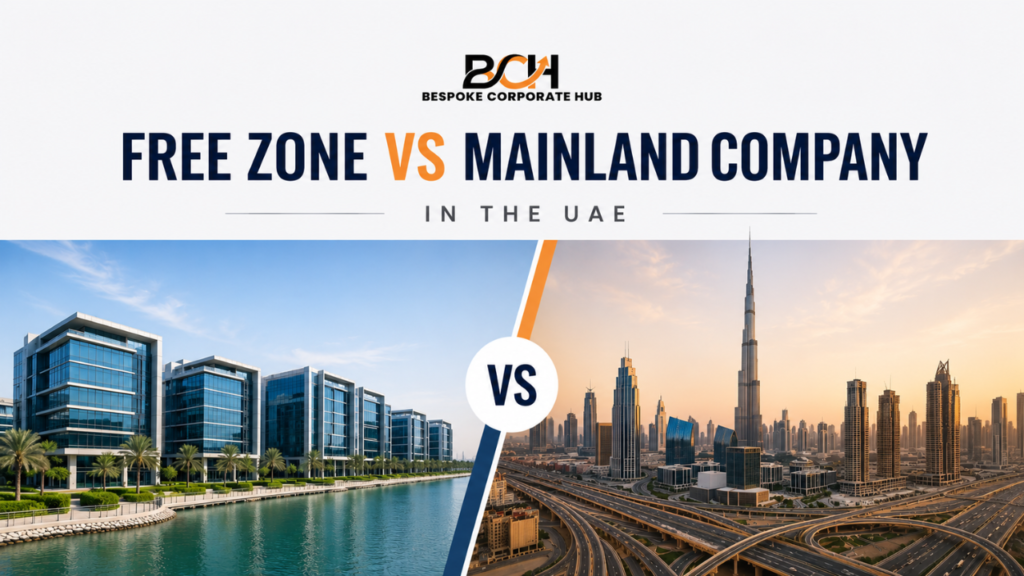
Starting a business in the UAE? One of the most important decisions you’ll make is choosing between a Mainland company and a Free Zone company. This choice will impact everything from your operational costs to your target market access, and getting it right from the start can save you time, money, and headaches down the road.
In this comprehensive guide, we’ll break down everything you need to know about both options in simple, easy-to-understand language, no confusing jargon, just practical insights to help you make the best decision for your business.
Understanding the UAE Business Landscape
The United Arab Emirates has built one of the world’s most attractive business environments. Whether you’re a startup founder, an established entrepreneur, or an investor looking to expand internationally, the UAE offers incredible opportunities.
When setting up a business here, you have three main jurisdictions to choose from:
- Mainland – Operating throughout the UAE
- Free Zone – Special economic zones with unique benefits
- Offshore – For international operations (not covered in this guide)
Today, we’re focusing on the two most popular choices: Mainland and Free Zone companies. By the end of this article, you’ll know exactly which option suits your business goals.
What is a Mainland Company?
A Mainland company is registered with the Department of Economic Development (DED) in one of the UAE’s seven emirates. Think of it as your all-access pass to doing business anywhere in the country.
Ownership Structure: The Rules Have Changed
Here’s some excellent news for international entrepreneurs: the UAE now allows 100% foreign ownership for Mainland companies in most sectors. This is a game-changer that happened in recent years.
Previously, foreign investors needed a UAE national to own 51% of the company (called a “local sponsor”). But those restrictions have been largely removed, opening doors for complete foreign ownership across hundreds of business activities.
Important note: Some strategic sectors still require local partnership, including:
- Oil and gas exploration
- Banking and financial services
- Certain security-related businesses
- Strategic utilities
For most businesses – retail, trading, services, manufacturing, technology – you can now own 100% of your Mainland company.
Market Access: Your Biggest Advantage
This is where Mainland companies truly shine. You get unrestricted access to:
- All seven emirates: Dubai, Abu Dhabi, Sharjah, Ajman, Fujairah, Ras Al Khaimah, and Umm Al Quwain
- Direct consumer sales: Open shops, showrooms, and retail outlets anywhere
- Government contracts: Bid on public sector projects
- Local B2B relationships: Work directly with UAE-based companies
- Healthcare and education sectors: Operate clinics, schools, or training centers
- Real estate activities: Engage in property-related businesses
If your business model involves selling to UAE residents or companies, a Mainland setup is often your best bet.
Office Space Requirements
You’ll need a physical office address in the Mainland. This means:
- Renting or purchasing commercial space
- Meeting minimum office size requirements (varies by emirate)
- Having a legitimate business address (not a PO Box)
The upside? Your office size directly correlates with the number of employee visas you can obtain, with no upper limit. Larger office = more visa quota.
Licensing and Business Activities
Mainland companies can engage in virtually any legal business activity:
- Commercial: Trading and distribution
- Professional: Consulting, legal, accounting services
- Industrial: Manufacturing and production
- Tourism: Hotels, travel agencies, tour operators
You’ll receive a trade license specifying your approved activities, and you can add more activities to your license as your business grows.
Best Suited For:
Mainland companies work brilliantly for:
- Retail businesses targeting local consumers
- Service providers working with UAE clients
- Distributors and suppliers to the local market
- Restaurants, cafes, and hospitality businesses
- Healthcare providers and educational institutions
- Construction and contracting companies
What is a Free Zone Company?
Free Zones are specially designated economic areas created by the UAE government to attract foreign investment. There are over 45 Free Zones across the UAE, each with its own focus and specialty.
100% Foreign Ownership – Guaranteed
Unlike Mainland (where 100% ownership is relatively new), Free Zones have always allowed complete foreign ownership. No local sponsor needed, no questions asked. You maintain full control of your business from day one.
Popular Free Zones and Their Specializations
Different Free Zones cater to different industries:
- DMCC (Dubai): Commodities trading, precious metals
- JAFZA (Jebel Ali): Logistics, manufacturing, trading
- Dubai Internet City: Technology and IT companies
- Dubai Media City: Media, marketing, and creative industries
- DIFC (Dubai International Financial Centre): Financial services
- Abu Dhabi Global Market (ADGM): Banking and finance
- Ras Al Khaimah Economic Zone (RAKEZ): General trading and manufacturing
- Fujairah Free Zone: Import/export and international trading
Market Access: Understanding the Limitations
Here’s the key difference: Free Zone companies are primarily designed for:
- International business and global trading
- Import and export operations
- Doing business with other Free Zone companies
- Providing services to clients outside the UAE
The limitation: To sell directly to customers in the UAE Mainland market, you’ll need to:
- Appoint a local distributor or agent (they earn a commission)
- Open a Mainland branch of your Free Zone company
- Work through business-to-business arrangements
However, many successful businesses operate this way. If you’re running an e-commerce store, software company, consulting firm, or international trading business, this limitation might not affect you at all.
Office Solutions: Maximum Flexibility
Free Zones offer various workspace options to suit different budgets:
- Flexi-desk: Shared coworking space (most affordable)
- Virtual office: Business address and mail handling
- Private office: Your own dedicated space
- Warehouse: For trading and logistics businesses
- Land plots: For manufacturing or large-scale operations
This flexibility means you can start small and scale up as your business grows. Many entrepreneurs begin with a flexi-desk package and upgrade later.
Visa Allocation
Most Free Zones tie visa quotas to your office package:
- Flexi-desk: 1-3 visas
- Small office: 4-6 visas
- Larger spaces: More visas
Some Free Zones also offer visa packages without office space requirements, making them incredibly cost-effective for small teams.
Business Activities and Licensing
Free Zone licenses generally fall into three categories:
- Trading License: Import, export, and distribution
- Service License: Consulting, IT, marketing services
- Industrial License: Manufacturing and production
You can typically add multiple activities under one license, giving you flexibility as your business evolves.
Best Suited For:
Free Zone companies are perfect for:
- E-commerce businesses serving international customers
- Software development and IT services
- Import/export and international trading
- Consulting firms with global clients
- Digital marketing agencies
- Holding companies for investments
- Logistics and freight forwarding
- Manufacturing for export markets
Deep Dive: Key Differences
1. Taxation and Financial Incentives
Both options enjoy the UAE’s tax-friendly environment:
- No personal income tax (for individuals)
- No withholding tax
- No dividend tax
- Full profit repatriation
However, Free Zones often offer additional perks:
- Guaranteed 0% corporate tax for 15-50 years (renewable)
- Exemption from import and export duties within the Free Zone
- No currency restrictions
- Simplified accounting requirements in some zones
Update for 2026: The UAE introduced a 9% corporate tax in 2023, but Free Zone companies meeting certain conditions can still qualify for 0% tax on qualifying income.
2. Customs and Import/Export
Free Zone companies:
- Zero customs duties on goods entering the Free Zone
- No customs on goods moving between Free Zones
- Duties apply only when goods enter the UAE Mainland
Mainland companies:
- Standard customs duties apply (typically 5%)
- Full access to UAE domestic market without restrictions
If you’re in the trading business, Free Zones can offer significant cost savings.
3. Company Structures
Mainland options:
- LLC (Limited Liability Company): Most common, 1-50 shareholders
- Professional Company: For licensed professionals (doctors, lawyers, consultants)
- Branch Office: Extension of a foreign company
- Civil Company: For UAE and GCC nationals only
Free Zone options:
- FZ-LLC (Free Zone Limited Liability Company): Multiple shareholders
- FZE (Free Zone Establishment): Single shareholder
- Branch of a foreign company
4. Setup Costs and Timeline
Mainland:
- Higher initial costs (typically AED 25,000 – 50,000+)
- Longer setup time (2-4 weeks)
- More documentation required
Free Zone:
- Lower initial costs (can start from AED 15,000 – 30,000)
- Faster setup (often 1-2 weeks)
- Streamlined processes
5. Renewal and Ongoing Costs
Both require annual license renewal, but costs vary:
- Free Zones often have fixed packages
- Mainland costs depend on office size, activities, and location
- Budget for visa renewals, office rent, and administration
Making the Right Choice: A Decision Framework
Still weighing your options? Use this framework:
Choose Mainland if you answer YES to these:
- Will you sell products/services directly to UAE consumers?
- Do you need to open physical stores or showrooms?
- Will you bid on government or local contracts?
- Is your target market primarily UAE-based businesses?
- Do you need unrestricted movement throughout all emirates?
- Are you in healthcare, education, or retail?
Choose Free Zone if you answer YES to these:
- Is your business primarily online or international?
- Do you want to minimize setup and operational costs?
- Are you focused on import/export trading?
- Do you serve clients outside the UAE?
- Do you want guaranteed tax benefits?
- Do you need flexible, scalable office solutions?
Can You Have Both?
Yes! Many successful businesses use a hybrid approach:
- Start with a Free Zone company for cost-effectiveness and tax benefits
- Later open a Mainland branch when you need direct market access
- Use the Free Zone for international operations and Mainland for local sales
This strategy gives you the best of both worlds, though it does involve managing two separate licenses.
Common Mistakes to Avoid
1. Choosing Based Only on Cost
The cheapest option isn’t always the best. Consider your long-term business goals, not just initial setup costs.
2. Ignoring Market Access Needs
If you’re planning to sell to UAE customers, a Free Zone-only setup will create hurdles. Think about where your revenue will come from.
3. Not Researching the Specific Free Zone
Each Free Zone has different rules, costs, and benefits. DMCC differs from JAFZA, which differs from Sharjah Media City. Do your homework.
4. Overlooking Visa Requirements
If you’re bringing a large team, ensure your chosen setup can accommodate the visa quota you’ll need.
5. Failing to Plan for Growth
Your business will evolve. Choose a structure that can scale with you.
The Bottom Line
Both Mainland and Free Zone companies offer exceptional opportunities in the UAE’s thriving business ecosystem. Your choice should align with:
- Your business model and revenue streams
- Your target market (local vs. international)
- Your budget and timeline
- Your growth plans
- Your industry and activity type
There’s no universally “better” option – only the right option for your specific business.
How Bespoke Corporate Hub Can Help
Navigating UAE business setup can feel overwhelming, especially if you’re new to the region. That’s where we come in.
At Bespoke Corporate Hub, we specialize in helping entrepreneurs and businesses establish themselves in the UAE. Our services include:
- Free consultation: We analyze your business and recommend the best setup
- License processing: We handle all paperwork and government approvals
- Visa assistance: We secure visas for you and your team
- Office solutions: We help you find the perfect workspace
- Bank account opening: We facilitate corporate banking setup
- Ongoing support: PRO services, renewals, and compliance
We’ve helped hundreds of businesses launch successfully in the UAE, and we’d love to help you too.
Ready to start your UAE business journey?
Contact Bespoke Corporate Hub today for a free, no-obligation consultation. Let’s turn your business vision into reality.
Have questions about UAE company formation?
Drop us a message, and our expert team will get back to you within 24 hours. Your success story starts here.